
Euclid Trip Blog
By Sam Charney and Sarah Kane


Sam: The week of June 26, 2023 marked several exciting moments for astronomy. On the evening of Wednesday, June 28, the NANOGrav collaboration released five papers detailing a massive announcement: evidence for the existence of a gravitational wave background. Then, on Thursday the 29th, the IceCube collaboration announced their findings of neutrinos mapping the disk of the Milky Way Galaxy, allowing us for the first time to see our own galaxy with neutrinos rather than light.
Penn’s astronomy group all gathered in our lounge to watch the two press releases in a back-to-back double feature. (Several of us joked that it was a mirror of the upcoming releases of the Barbie and Oppenheimer movies on the same day in July. I personally think that NANOGrav is Barbie and IceCube is Oppenheimer in that comparison, but apparently that’s controversial!) Sitting on the floor of the lounge, I kept half an eye on my computer as I prepared for the most spontaneous travel of my life: a trip to Florida beginning the following morning.
Professor Bhuvnesh Jain, our group’s faculty supervisor, is a member of the Euclid collaboration. Along with Professor Gary Bernstein, he helped make the case for Euclid’s existence. Euclid is a mission sponsored by the European Space Agency and consists of a space-based telescope designed to map the cosmos and to help astronomers answer some of the most mysterious unanswered questions in the field. This field of astronomy, which deals with the large-scale contents, structure, and formation of the universe is what we call cosmology. Broadly speaking, the Euclid telescope is the first space-based cosmology telescope in decades. We seem to be entering a new era of space-based cosmology observations, however, as the Nancy Grace Roman Space Telescope (built by NASA) will also be launching within the next several years. Many members of Penn’s faculty will be involved in the analysis of data from the new telescope. Euclid’s imaging, which will be approximately four times better than that of ground-based telescopes, will cover a large portion of the sky, giving Euclid data the potential to revolutionize any field of astronomy that relies on large samples and wide imaging. More on the mysteries of dark matter and dark energy—as well as Euclid’s role in understanding both—later.
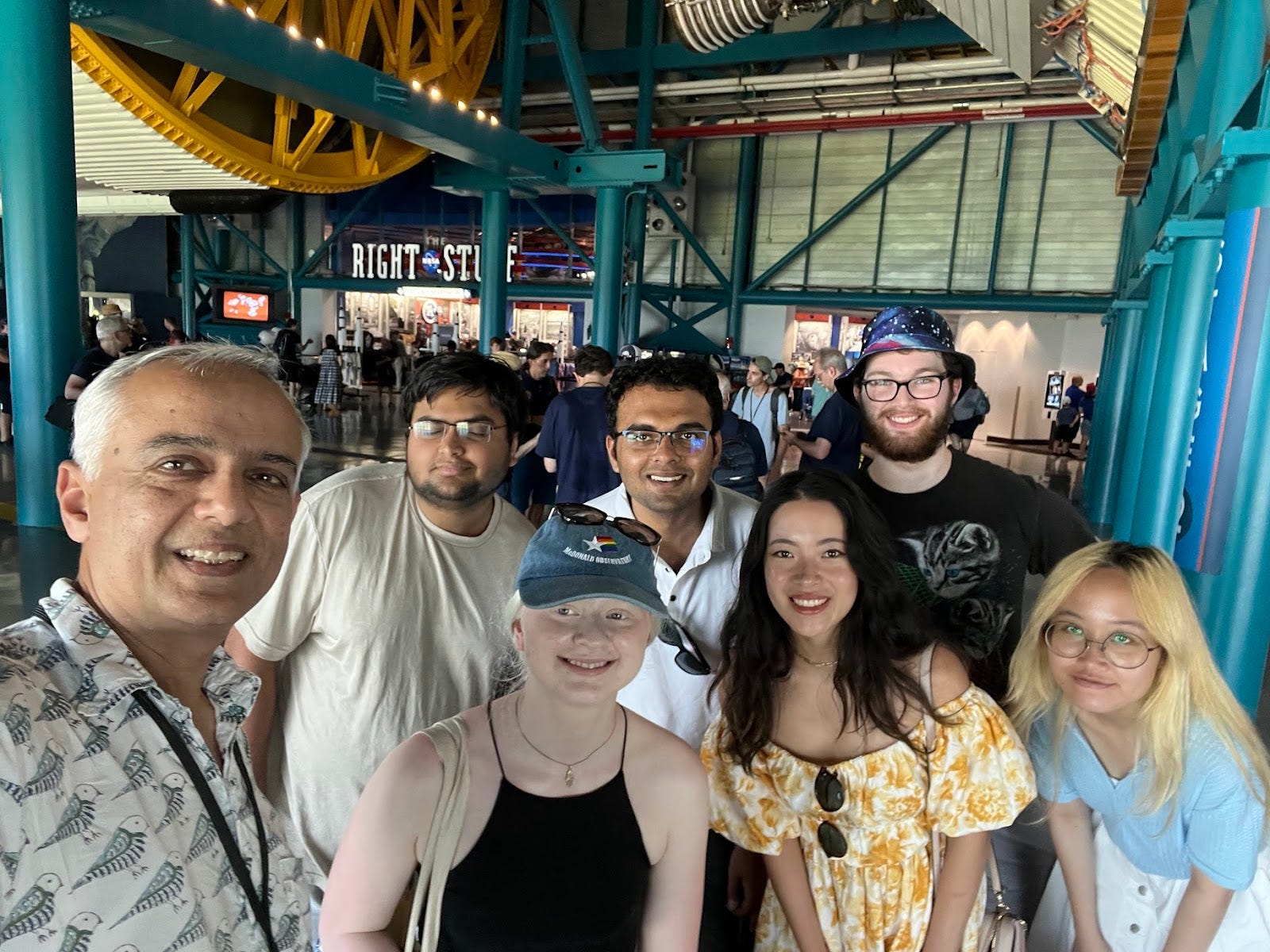
Sarah: As a member of the Euclid collaboration, Professor Jain was invited to watch the rocket bearing the Euclid telescope launch on Saturday, July 1st, which marked the third major event in astronomy for that week. When Professor Jain extended the offer to any member of our research group to go to Cape Canaveral to watch the launch, Sam Charney and Mathilda Nguyen (rising senior undergraduates from Penn and Drexel, respectively), and I all jumped at the opportunity. It was especially exciting since Penn’s Center for Particle Cosmology would fund our trip! With our flights and AirBnB booked mere days before our departure, the decision to travel for the launch marked one of the most impromptu yet exciting plans that I, a chronic planner, had ever made. When we got to Florida we also learned that we were three of only four undergraduates in the entire watch team.
8 a.m. dawned bright and—at least for a group of three undergraduates—early on Friday as we piled ourselves into a car and off to the Philadelphia airport. Sam and I kept turning to each other and just saying “Florida!” “FLORIDA!”, so I think we were both still a bit shocked to be going. The flight itself was uneventful aside from Elana, my Seeing Eye dog, entirely taking over Sam’s foot space and becoming progressively more demanding that he pet her. Fortunately, she’s a pretty happy flier.
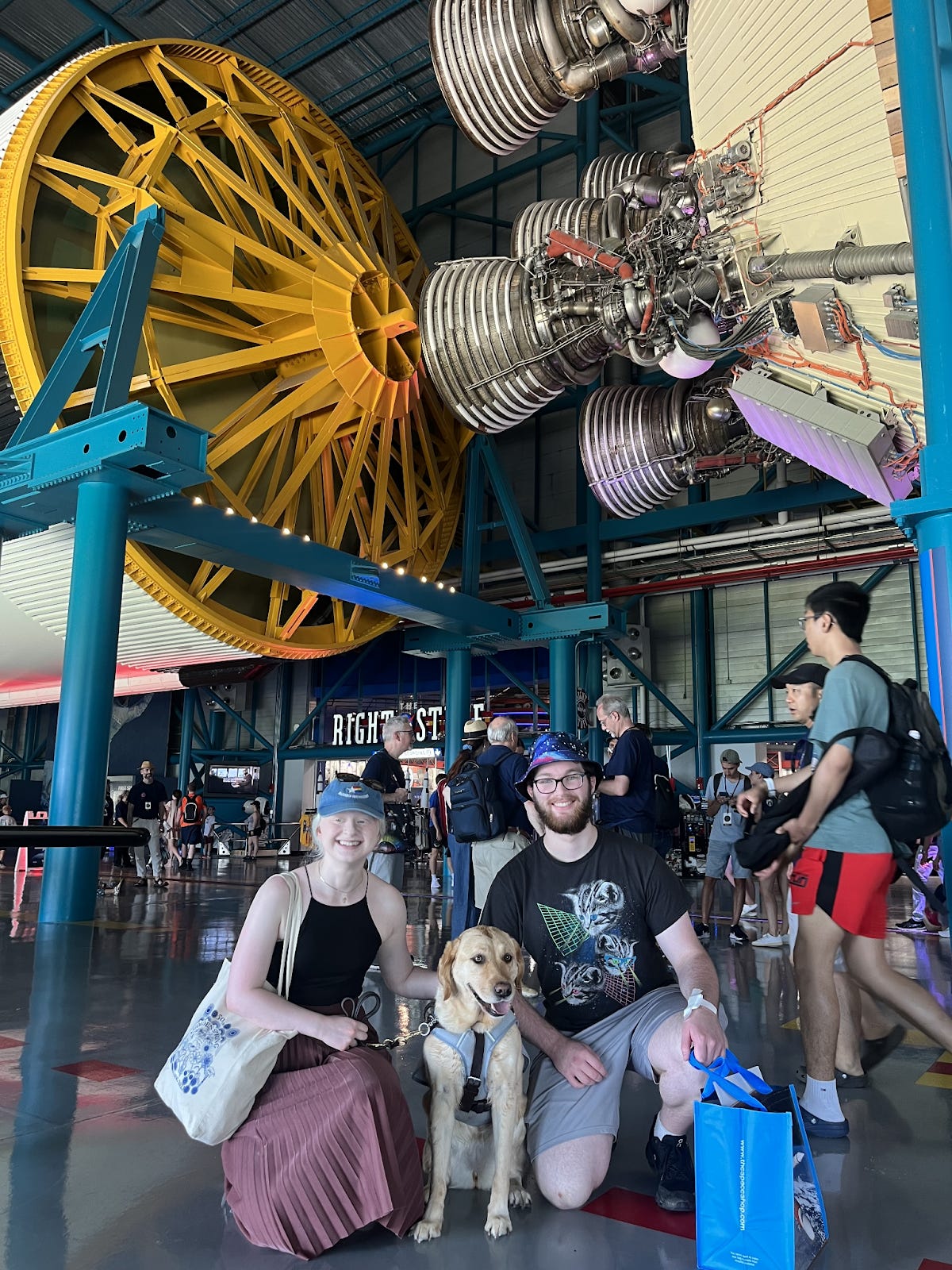
Sam: The first day we mostly spent settling in and trying to stay out of the Florida heat. The following morning we made our way to the Kennedy Space Center for the launch. Even the trip to the launch viewing site, a place called Banana Creek, featured a wealth of information about the United States’s history of spaceflight. There was a very long building that housed an entire Saturn V rocket. Having to walk several minutes to get from one end of the rocket to another really puts the size of normally distant objects into perspective. Sarah and I remarked to each other that we knew surprisingly little about the actual methods of reaching space. Often when I tell people that I study astrophysics, their first response is to exclaim “Oh, so you’re a literal rocket scientist!” That always makes me laugh, as I know next to nothing about how a rocket works—and you absolutely should not trust me with an engineering project!
Sometimes, studying astronomy, I forget that humans have actually been out there—perhaps not to other planets or stars, but beyond Earth’s atmosphere and even to the moon. There is something awesome about that: the fact that we have taken the first steps beyond our own world. It takes thousands of highly trained engineers and scientists working together to get just a couple of individuals, or just one telescope, into space.
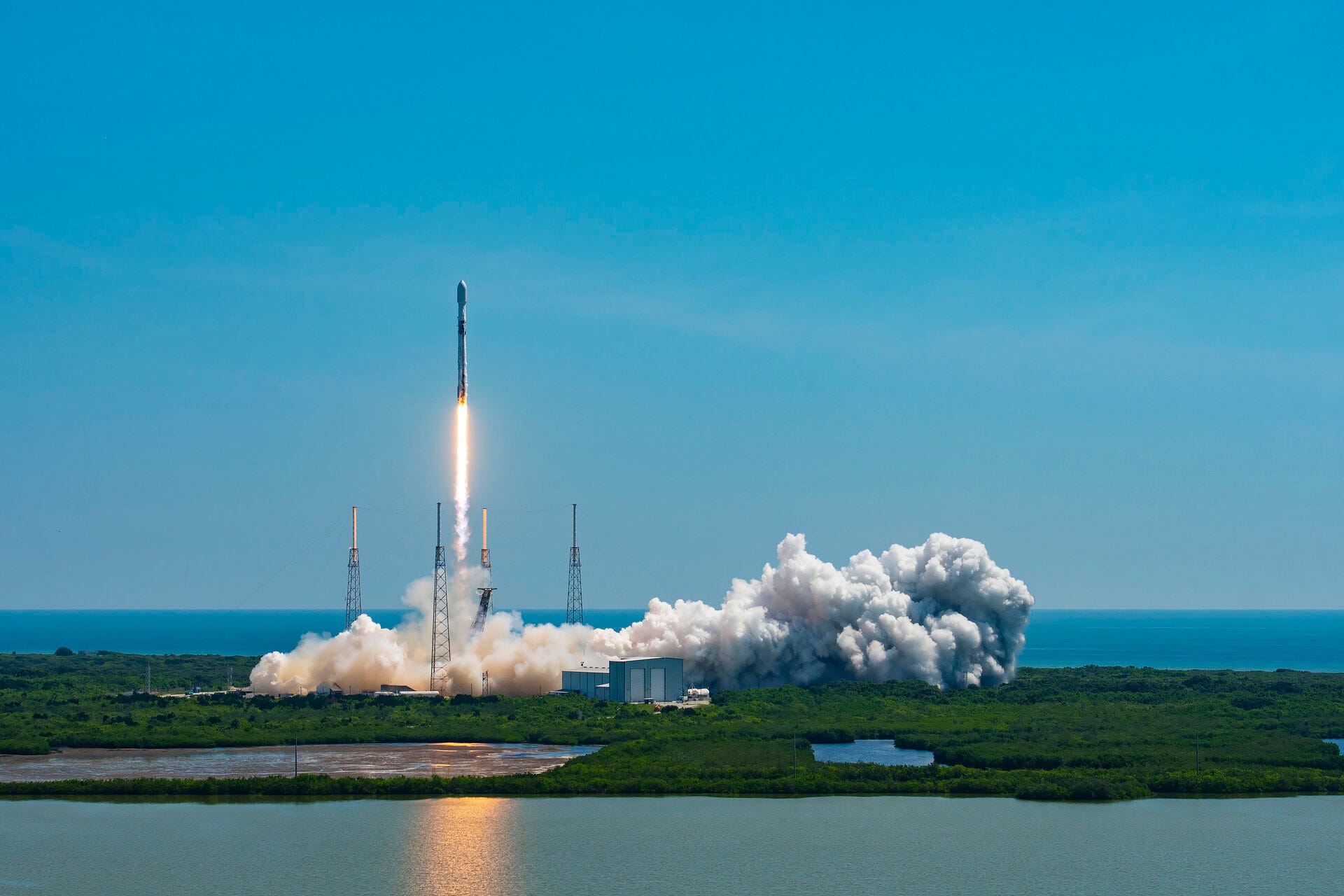
Sarah: I could not actually see the rocket launch—not surprising, given the blinding Florida sun—but I certainly could hear it. The sound of the rocket launching washed over us in pulses of noise, so strong that you could feel the air vibrating around you. The sound wasn’t unpleasant, but it certainly was impressive, especially given how far we were from the launch. (Elana seemed completely unfazed; I suppose she was still too busy pouting about the water I had dumped over her to keep her cool.)
What surprised me most was the delay between the gasps I heard from the assembled crowd as they saw the rocket launch and the time the sound actually hit us. Of course, I know that light travels much, much faster than sound; the speed of light is practically ingrained in my memory after so many years of physics classes: about 300,000,000 meters per second! However, it is one thing to know that that is a mind-numbingly fast pace and quite another to witness evidence of it first-hand. Situated six miles away from the launch site, so much time passed between the launch itself and the moment the sound waves arrived that I had begun to wonder if we would hear anything at all. Such is the majesty of astronomy: the scale of the numbers we work with is so large, so incomprehensible, that the breadth and depth of things perpetually astonish. We live in a galaxy with hundreds of billions of stars, in a universe with hundreds of billions (or more) galaxies just like it out there. That vastness along with the huge distances between all of those objects makes even that incredible speed of light seem glacial. At the launch, we truly glimpsed the scale of the numbers we use every day.
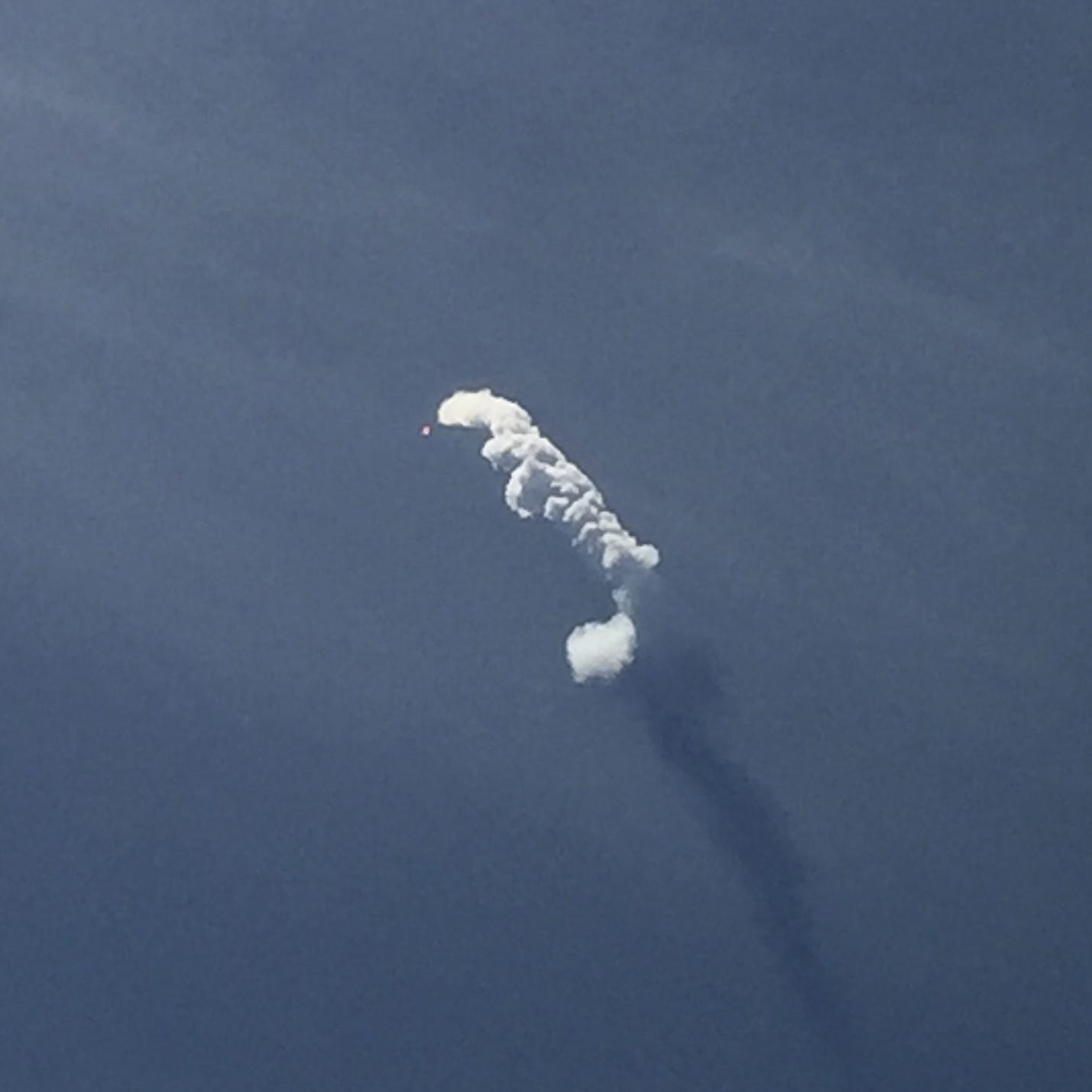
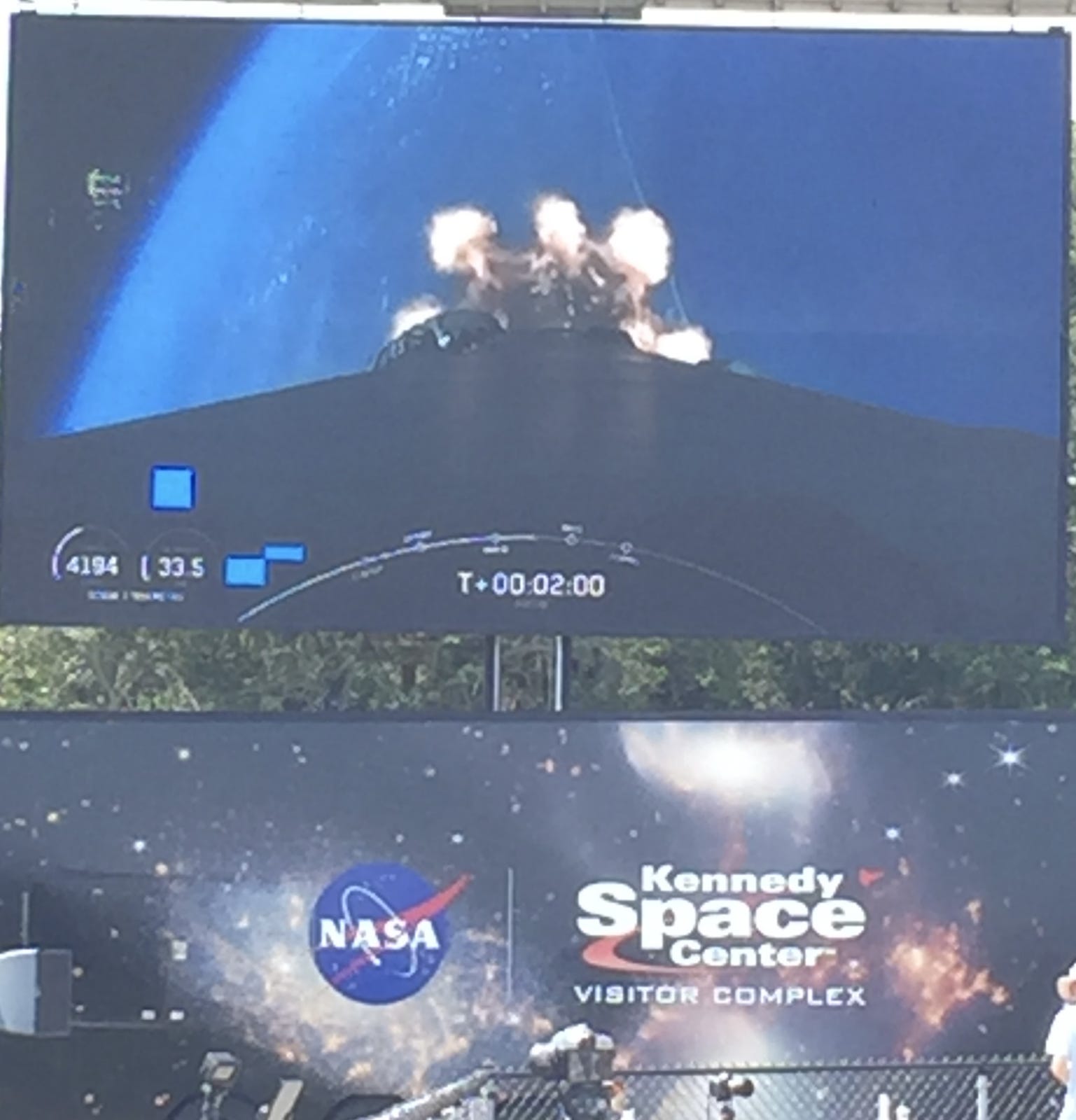
Sam: As we approached launch time, I divided my attention between the actual launch site some six miles away and the giant screen showing close-ups of the rocket and the countdown. This screen was on more of a delay than I thought, so I did not realize the rocket was launching until I heard cheers from the ESA scientists on my right and saw the bright light from the engines. At first, the rocket seemed to move so slowly, as if the air was made of molasses. From that distance, the launch itself was not much of a visual spectacle, but about 30 seconds after launch, the sound reached me. It started as a low hum as engines began the ignition sequence then crescendoed until you could feel the air vibrate with the power of the rockets. The sound was honestly the most impressive part of the launch itself, along with the perfect demonstration of how much slower sound is than light. Once it reached the upper atmosphere, water vapor from burning fuel created a cloud-like line called a contrail. This trail allowed anyone watching to trace the rocket’s path long after it disappeared from sight. After this point, the screen was our only source of information—it showed a video feed from the rocket as well as the speed and altitude. The display split when the first stage of the SpaceX Falcon 9 detached and showed it land on a relatively small barge off the coast of Cape Canaveral for reuse. It was incredible to see all of that happen in real time and think about all the engineering and software that went into making that possible.
Once in space, the Euclid telescope will take about a month to reach its destination—the second Lagrange point (L2)—a region 1.5 million kilometers (~1 million miles) past the Earth, as viewed from the Sun. Objects at this point are affected by a combination of the Sun’s immense gravitational force and the Earth’s comparatively paltry counterpart. This combination allows objects to orbit at the same rate as Earth so we can remain in easy contact with them for the entirety of their service life. It also allows a telescope to always point directly into space and be able to easily shield itself from the Sun. The Euclid observatory will join NASA’s James Webb Space Telescope and the Gaia telescope, another ESA project, at the L2 Party. Once the telescope arrives, there will be about two months of performance tests and calibrations, and then the telescope will begin its official survey with the Phase Calibration Diversity stage, after which standard observations will begin.
Sarah: Following the Euclid launch, there was a three day meeting of the collaboration in one of the nearby hotels. After a few more hours exploring the Kennedy Space Center (including an all-important stop at the gift shop to get souvenirs for ourselves, our friends, and family), we headed over to the conference to hear a few of the talks. When we arrived, one of the staff members printed Euclid name tags for Sam, Mathilda, and I, which I found amusing given that none of us actually work with the telescope. I sent a photo of my name tag to a few friends with the caption “Posing as a cosmologist for the day!” (My research interests tend to be in the field of Galactic archeology, using stars—Galactic “fossils”—to trace the history of our very own Milky Way Galaxy.)
The first talk we heard covered the data release process for the Euclid mission. The data will be made publicly available in three main data releases; this public availability of telescope data is one of the great strengths of modern astronomy, as it allows the scientific community to make broad use of the wealth of information and resources. Members of the Euclid collaboration will have early access to the data to write papers to be released along with the public data. As someone usually on the public end of data releases, excitedly scrambling to download data when it is made available, I felt like I was peering into the inner workings of the field!
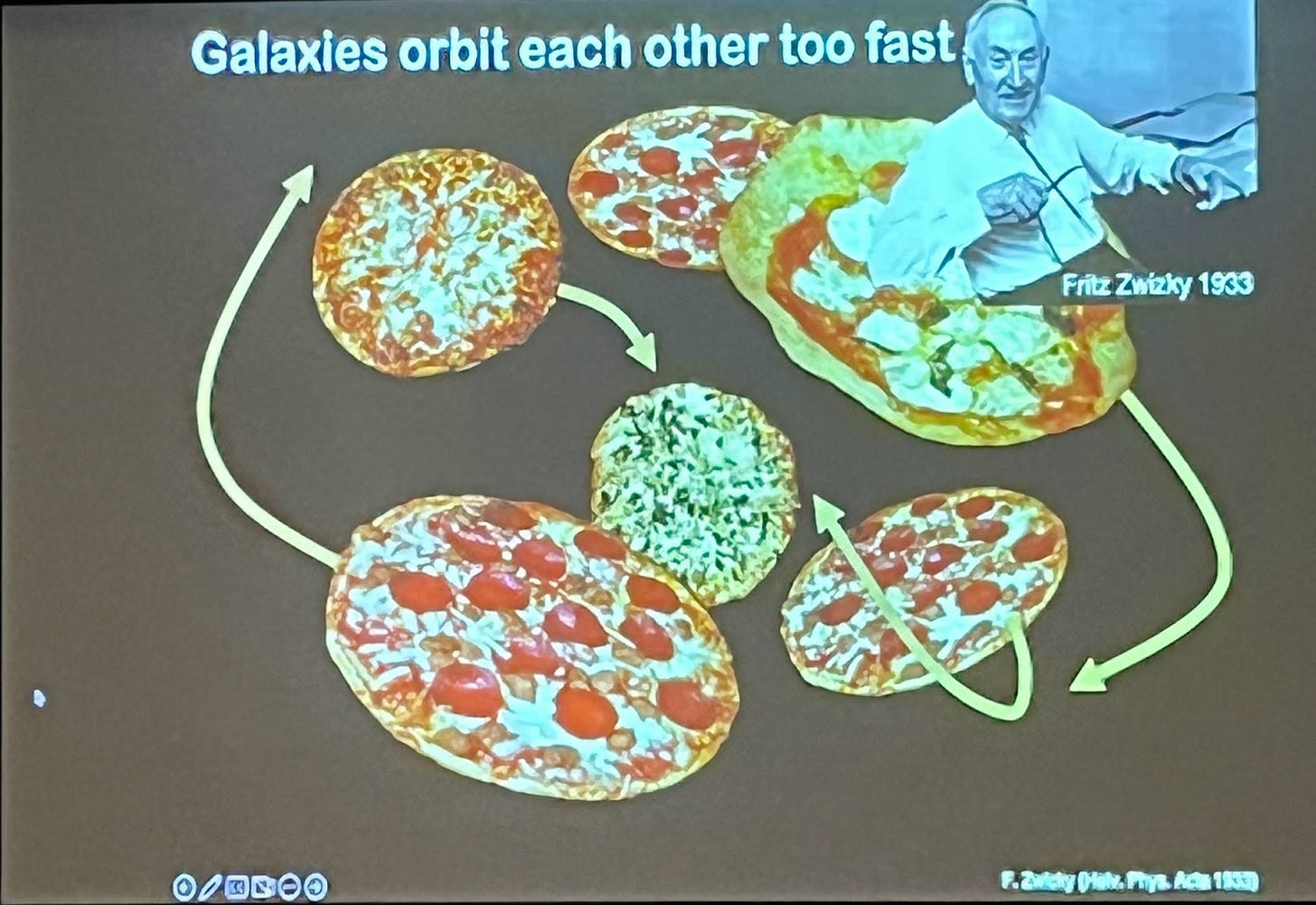
Next was a talk about the history and mission of Euclid. The speaker, Dr. Richard Massey, was so engaging! Dr. Massey had just come from a conference in Italy, so his presentation was full of some wonderful pizza analogies.
Sam: Earlier, I promised more details about cosmology and by extension Euclid’s mission, which I can now dive into via the useful lens of Dr. Massey’s talk. To discuss the Euclid mission and its goals, we’ll need to know about two astronomical concepts (which often show up as popular buzzwords in science media): dark matter and dark energy. The nature of dark matter and dark energy, invisible substances that nonetheless make up the majority of the universe’s substance and have observable effects on so-called “normal” matter, is almost a complete mystery to us. Euclid is designed to pull back the curtain on some of the mystery, and more than 2,000 scientists in the collaboration are ready to receive, process, and analyze the data from the mission to that end.
Even though we cannot observe dark matter directly, we can still detect its presence via gravitational effects on normal matter, particularly via a phenomenon called lensing (Professor Jain’s main area of study). Most of the matter in the universe is not directly visible to humans, but Euclid’s sharp images will help make much better maps of dark matter than we can from the ground. Dark energy, dark matter’s even more mysterious sibling, is the name that astronomers have given to the unknown force that is causing the rapid and accelerating expansion of the universe. These two strange and invisible forces make up over 95% of the Universe and will be the cause of its eventual demise. A sobering thought. Euclid, by tracing the speeds of receding distant galaxies and thus the expansion rate of the universe, will give cosmologists unique insights into this perplexing dark energy.
The Euclid Telescope, which will observe about one third of the sky beyond the Milky Way at distances up to 10 billion light-years from Earth, is uniquely positioned to observe gravitational lensing and far-flung galaxies. This will help it discover the distribution of dark energy and dark matter, and hopefully grant some insight into their nature. Since the light from a galaxy 10 billion light-years away took 10 billion years to reach us here on Earth, the Euclid Telescope will also allow astronomers to see into the past, map the formation of galaxies throughout the history of the universe, and trace the development of the cosmic web upon which those galaxies lie.

Sarah: Dr. Massey’s talk, pizza diagrams and all, was a fun review of some fundamental concepts of cosmology, and because we flew back to Philadelphia the next day, it was a great way to end our Euclid trip. Also, Dr. Massey threw Sam a fake cheese cube that a mouse pops out of when you squeeze it, which he used to explain the concept of pressure. I, unfortunately, sat next to Sam, and I think I saw my life flash before my eyes as that cheese cube flew towards me, but once he had caught it, I will admit to being somewhat jealous of his souvenir.
After the Euclid meeting concluded, we had dinner that night and lunch the following day with the graduate students from Professor Jain’s group who had also come to the launch. We always enjoy getting to know the grad students a little better; it’s like a glimpse into our futures! Following a couple games of chess in a bubble tea shop on Sunday (Mathilda beat Sam), we were off, back to Philadelphia in time for work the next day. As we flew back, I couldn’t help but reflect on the celebratory mood—and palpable relief—among the Euclid team after the launch. (I literally shudder to imagine what the mood might have been if something had gone wrong!) About four hundred Europeans came to watch the launch, which might seem like an awful lot of trouble to go to, but as Professor Jain put it, many of these people had been working on Euclid for half of their careers or more. It seems only fitting, then, that they got to see its journey into space
 | A guest post by
|
SAM!! This is fantastic and fascinating and cool and amazing all at once! A delightful read.